 Larkspur Edit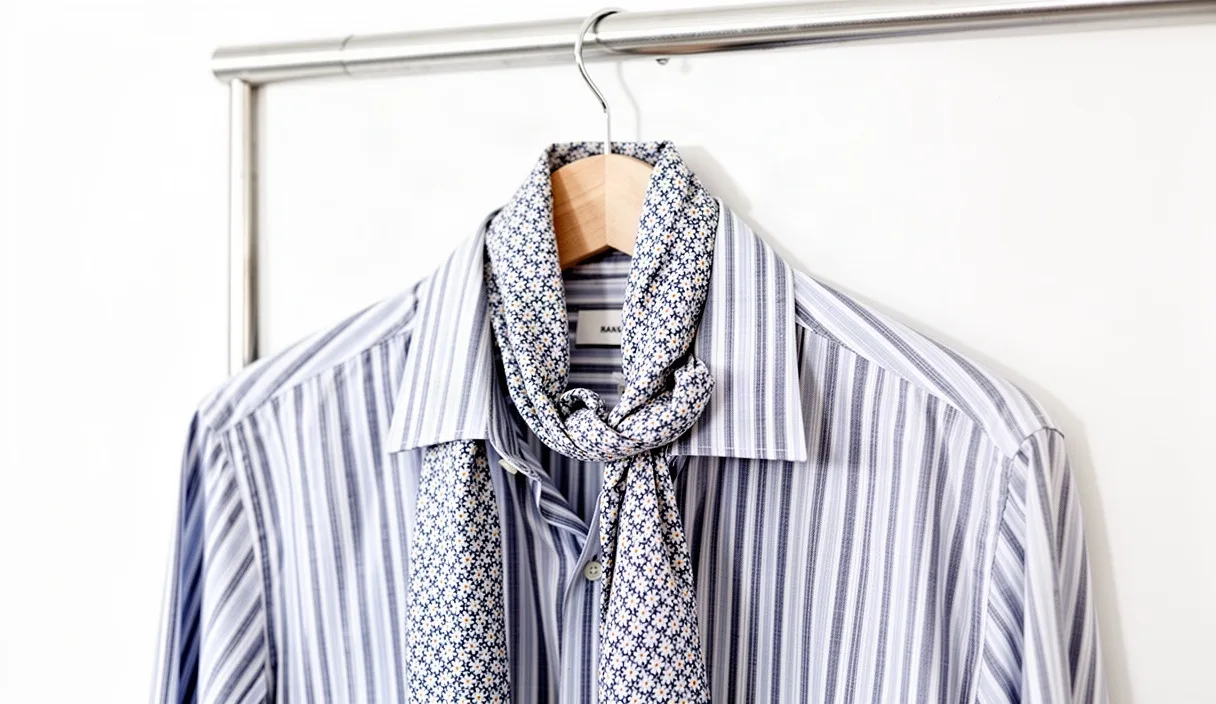

We get asked about pattern mixing more than almost anything else in the wardrobe-building category. There's a reason for that: most of us were taught, somewhere along the way, that patterns clash and the safe move is to stick with solids. That advice isn't wrong, exactly, it's just incomplete. Patterns can clash, but they don't have to, and once you understand a few simple rules, mixing them becomes less of a gamble and more of a skill you can repeat on purpose.
This guide walks through the logic we use ourselves when we're getting dressed or helping a friend pull together an outfit. We'll cover scale, color, easy starter combinations, when a third pattern actually works, and the mistakes that tip an outfit from "interesting" into "busy." By the end, you should have a method, not just a list of outfits to copy.
Why Pattern Mixing Feels Risky at First
Patterns feel risky because they carry visual weight. A solid navy sweater sits quietly in an outfit. A navy sweater with a bold stripe pulls your eye toward it immediately. When you put two patterns together, you're asking the eye to process two sets of visual information at once, and if neither one gives the eye a place to rest, the outfit reads as cluttered rather than put-together.
Part of the hesitation also comes from how clothing is usually sold and styled. Most ready-made outfit photos pair one pattern with solids, because that's the safest combination to photograph and sell. So we rarely see pattern-on-pattern modeled in everyday life, which makes it feel like an advanced move reserved for people with some innate sense of style. It isn't. It's a set of relationships between scale, color and spacing, and those relationships can be learned.
The good news is that the fear is usually bigger than the actual risk. A striped shirt under a plaid jacket, a floral skirt with a gingham top, these combinations have been worn for decades in classic menswear and womenswear alike. The difference between a mix that works and one that doesn't usually comes down to one or two adjustable factors, which is exactly what the next few sections break down.
The Scale Rule: Big Pattern, Small Pattern
If you remember only one rule from this article, make it this one: pair a large-scale pattern with a small-scale pattern. When two patterns are similar in size, they compete for attention and the eye doesn't know where to settle. When one pattern is clearly bigger and one is clearly smaller, they separate into a foreground and a background, and the outfit reads as intentional.
Think in concrete terms. A pinstripe shirt has a repeat of maybe a quarter inch between lines. A windowpane check jacket might have a repeat of two to three inches between lines. Worn together, the pinstripe reads almost like texture next to the bigger, more graphic check. That size gap is what makes the combination feel calm instead of noisy.
A practical way to test this before you buy or wear something: hold the two garments at arm's length and squint slightly. If you can still tell both patterns apart easily, they're probably too similar in scale. If one blurs into a texture while the other stays graphic, you've likely got a workable pair.
- Small patterns include pinstripes, micro-houndstooth, fine gingham (under half an inch), and small polka dots (under a quarter inch).
- Medium patterns include standard stripes, medium plaid, and classic houndstooth.
- Large patterns include big floral prints, bold windowpane check, wide stripes, and large-scale animal print.
A reliable starting formula is small plus large, skipping medium for your first few tries. Medium patterns are harder to pair with each other because they sit too close in visual weight, so save those combinations for once you've got more practice reading scale by eye.
Using Color to Tie Patterns Together
Scale handles the shape of the mix, but color is what makes it feel cohesive rather than accidental. The easiest method is to find one color that appears in both patterns, even if it's a minor accent in one of them, and let that shared color act as the connective thread.
For example, a navy and white striped top paired with a navy, red and white plaid skirt works because navy and white show up in both pieces. Your eye catches that repetition even if you don't consciously register why the outfit feels balanced. This is the same principle interior designers use when mixing patterned pillows on a sofa: a shared color across different prints keeps a room from looking like a grab bag.
If the patterns don't share an obvious color, you can still make them work by keeping the overall palette narrow. Two patterns that both lean warm and muted, think rust, olive and cream, will sit together more comfortably than one warm-toned pattern paired with one cool, high-contrast pattern like black and electric blue.
| Pattern 1 | Pattern 2 | Shared element | Result |
|---|---|---|---|
| Navy pinstripe shirt | Red and navy plaid scarf | Navy | Cohesive, easy |
| Black and white houndstooth blazer | Black polka dot blouse | Black | Cohesive, classic |
| Olive floral dress | Rust and cream gingham jacket | No exact match, same warm family | Works, slightly bolder |
| Bright orange stripe top | Cool blue and purple abstract print | None | Harder to pull off, proceed carefully |
When in doubt, pick the pattern you love most and build the rest of the outfit around one of its colors. This keeps the decision simple: you're not solving a color-matching puzzle from scratch, you're just echoing a color that's already there.
Easy Combinations to Start With
If you're new to this, start with combinations that have a built-in safety net. These pairings are forgiving because the scale difference is large and the color overlap is usually automatic.
- Stripe plus floral. A striped top under a floral dress, or a striped scarf with a floral skirt. The straight lines of the stripe contrast cleanly with the organic shape of the floral, and if the stripe picks up one color from the floral, the pairing almost styles itself.
- Gingham plus plaid. Small gingham (quarter inch or smaller) under a larger plaid jacket or coat. Both are grid-based patterns, so they share a visual logic even though their scale is different.
- Polka dot plus stripe. A small polka dot blouse under a wider-striped blazer. This is a classic combination in both menswear and womenswear because dots and stripes are both simple, repeating shapes that don't fight for attention.
- Animal print as the "neutral." Leopard print in particular tends to act like a neutral once you're used to seeing it, so a leopard scarf or shoe can be added to almost any other pattern as long as the colors in the leopard print, usually brown, black, and cream, appear somewhere else in the outfit.
Try one of these combinations with pieces you already own before buying anything new. A striped shirt you already have, paired with a floral skirt already in your closet, is a free way to test whether pattern mixing suits how you like to get dressed.
When to Add a Third Pattern
A third pattern is possible, but it's where most outfits start to tip into chaos, so it deserves a stricter rule than the first two. Our guideline: only add a third pattern if it's small-scale and appears in a minor accessory, such as a tie, a pocket square, socks, or a thin headband, not in a main garment like a shirt, jacket, or skirt.
The reason is simple math. Two patterns already split the eye's attention. A third pattern in another main garment splits it a third way, and most outfits can't support that without looking like they were assembled at random. But a third pattern confined to a small area, like a polka dot pocket square with a striped shirt and plaid jacket, reads as a deliberate accent rather than a competing focal point.
A useful check before adding a third pattern: cover the small accessory with your hand and look at the outfit without it. If the outfit already looks complete and balanced, the third pattern is optional decoration, which is exactly the role it should play. If the outfit looks unfinished without it, something is off with the first two patterns, and adding a third one won't fix that.
Mistakes That Make an Outfit Look Busy
Most pattern-mixing failures come down to a short list of repeatable mistakes, and knowing them in advance makes them easy to avoid.
- Matching patterns too close in scale. Two medium plaids, or two medium stripes, will almost always compete rather than complement, even if the colors match.
- Ignoring color entirely. Two patterns with zero shared color and opposite temperatures (warm versus cool) rarely feel intentional, even with good scale contrast.
- Adding a third pattern in a main garment. A striped shirt, plaid jacket, and checked trousers worn together is a lot to ask of one outfit, even for an experienced dresser.
- Skipping a plain anchor piece. Shoes, belts, or bags in a loud third pattern can undercut an otherwise balanced top-and-bottom pairing. Keep at least one element, often the shoes or the bag, solid and simple.
- Using high contrast in both patterns at once. If pattern one is stark black and white, and pattern two is also stark black and white, the combined effect can feel aggressive rather than balanced, even though the colors technically "match." Softening one of the two with a muted or tonal version of the same pattern often helps.
If you try an outfit on and it feels like too much, the fix is usually subtraction, not addition. Remove the smaller pattern first, check if the outfit improves, and then decide whether to bring it back in a smaller dose, like a single accessory instead of a full garment.
Next Steps: Building Your Own Pattern-Mixing Habit
The fastest way to get comfortable with pattern mixing is to practice low-stakes, at home, before you commit to wearing a combination out. Lay two patterned pieces you already own side by side on a bed or a chair, apply the scale rule and the shared-color check from this article, and see what you notice.
Keep a short mental list, or even a note on your phone, of combinations that worked for you personally. Everyone's closet leans toward certain colors and pattern types, and the combinations that feel natural to you will likely repeat once you find a formula that fits your existing wardrobe.
Start with one new combination a week rather than overhauling every outfit at once. If you're shopping for new pieces specifically to mix patterns, buy the small-scale pattern first, since it's more versatile and will pair with more of the larger patterns you already own or might buy later. And if you're ever unsure in the moment, the safest fallback is still the original easy pairing: one small pattern, one large pattern, one shared color. It's a simple formula, but it covers most situations you'll run into while getting dressed.